2026-10-26Compare
After Luna’s 80% Cut and DeepSeek Peak Pricing: How to Pick Your API Bill in Fall 2026
Open your cloud dashboard or glance at your team’s latest API bill this fall, and the numbers tell an unsettling story. A few months ago, evaluating AI API pricing meant scanning a single flat rate card per model. That straightforward math evaporated over the summer. When OpenAI delivered the Luna 80% cut on July 30, it dropped utility-tier inference down to commodity territory. Just over two weeks later, DeepSeek abolished flat pricing entirely, splitting its catalog into aggressive peak and off-peak rate schedules. Add in Anthropic locking in competitive Sonnet pricing, and engineering teams are no longer asking who published the flashiest markdown.
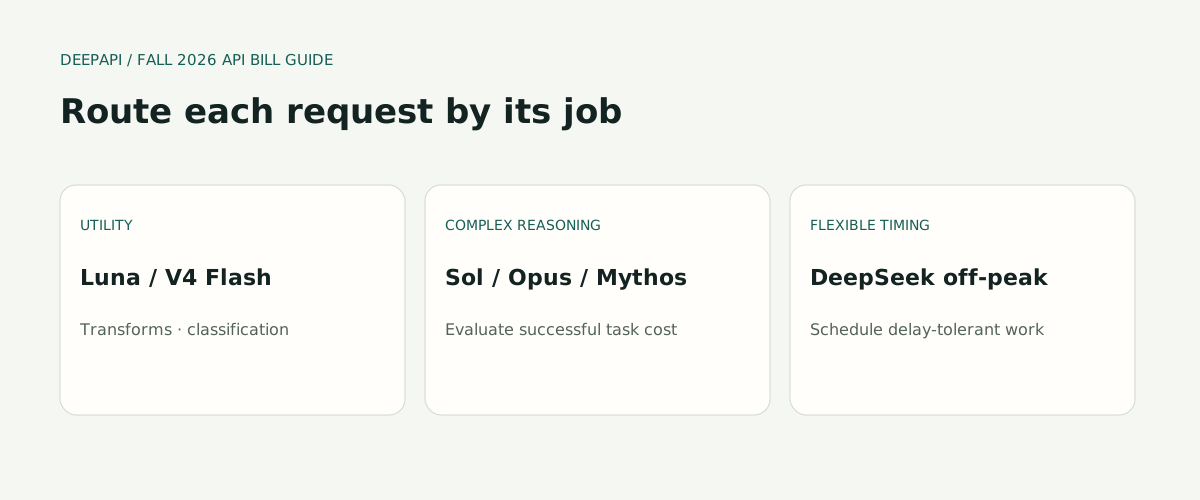
The real buying question in fall 2026 is operational: Which provider route actually minimizes your net API bill across your specific prompt lengths, cache-hit ratios, latency limits, and execution hours? Rather than rehashing the summer price storm blow-by-blow, this buying guide delivers an actionable decision framework for your stack today. If you need the historical narrative and scoreboards, consult our earlier guides on the summer 2026 price war and token spend shift and the August 2026 model pricing storm. For everything else, let us break down what you should run tonight.
| Model / Tier | List Input / Output (per 1M tokens) | What Changed in Summer 2026 | Best For | Watch-Outs |
|---|---|---|---|---|
| GPT-5.6 Luna | $0.20 input / $1.20 output | Slashed ~80% (from $1.00 / $6.00) on July 30 | High-volume background pipelines, light transforms, classification | Token bloat on multi-step reasoning; task cost can outrun list rate |
| GPT-5.6 Terra | $2.00 input / $12.00 output | Trimmed ~20% (down from $2.50 / $15.00) | General enterprise agentic workflows, mid-complexity synthesis | Squeezed from below by Luna and across by Sonnet 5 |
| GPT-5.6 Sol | $5.00 input / $30.00 output | Unchanged | Deep architectural reasoning, high-stakes edge cases | Severe cost penalties if sent unvetted batch tasks |
| DeepSeek V4 Pro (Off-Peak) | $0.022 (cache-hit) / $0.66 (cache-miss) / $1.98 output | Replaced flat $0.435 / $0.87 pricing on August 16 | Scheduled nocturnal batch jobs, continuous indexing, off-hours coding runs | Still 2× more expensive on output than the old flat rate |
| DeepSeek V4 Pro (Peak) | $0.044 (cache-hit) / $1.32 (cache-miss) / $3.96 output | 2× of off-peak; active during Asian business hours (01:00–04:00 & 06:00–10:00 UTC) | Real-time interactive user agents demanding frontier Chinese/coding parity | Peak output is ~4.6× higher than the old flat $0.87 rate |
| DeepSeek V4 Flash (Off / Peak) | Miss: $0.22 / $0.44; Out: $0.66 / $1.32; Hit: $0.007 / $0.014 | Shifted from flat $0.14 miss / $0.28 out to dynamic window | Fast high-throughput triage, routing layers, developer sidecars | Peak output quadrupled compared to summer flat pricing |
| Claude Sonnet 5 | $2.00 input / $10.00 output | Planned hike to $3/$15 scrapped; $2/$10 established as permanent standard | Coding assistants, structured data extraction, document reasoning | Claude 4.7+ tokenizers may generate ~30% more tokens on identical strings |
| Claude Opus 5 | ~$5.00 input / ~$25.00 output | Framed at "half-price" relative to top-tier Claude Mythos ($10/$50) | Complex autonomous agents, system design reviews, mission-critical code | Premium pricing demands strict invocation triggers |
| Claude Mythos 5 | $10.00 input / $50.00 output | Anchors the absolute enterprise ceiling | Zero-compromise frontier intelligence, legal/compliance validation | Massive financial impact on unmonitored loops |
Fall 2026 API Bill at a Glance
The table below summarizes the key tier moves that define current production costs. Figures reflect rate cards as documented in our comparative trackers (updated September 13, 2026). Real-time variations across direct endpoints and third-party hosting appear in our live Model API Price catalog.
Note: For the latest changes, spot discounts, and live platform telemetry, cross-reference our Model API Price index and active promotions on Deals.
What Actually Changed (Summer → Fall)
To budget accurately for the rest of 2026, engineering managers must distinguish genuine structural deflation from clever rate-card repositioning:
- The Utility Tier Crashed 80%: When OpenAI dropped GPT-5.6 Luna to $0.20 per million input and $1.20 per million output tokens, it established an aggressive new baseline for commodity API volume. For a standard 1M-in / 1M-out payload, aggregate list cost dropped from roughly $7.00 to $1.40. Detailed breakdown is available in our token spend shift analysis.
- Flat API Pricing Is No Longer the Default: On August 16 at 16:00 UTC, DeepSeek officially discarded uniform global rate cards. It partitioned usage into two daily peak windows (01:00–04:00 UTC and 06:00–10:00 UTC, matching 09:00–12:00 and 14:00–18:00 Beijing time) and off-peak windows. Crucially, off-peak is not a discount against the legacy baseline; on DeepSeek V4 Pro, off-peak output ($1.98/1M) is more than double the old flat price ($0.87/1M), while peak output ($3.96/1M) sits at 4.6× the old rate. Our August model pricing storm
- report covers this architectural pivot in depth.
- Anthropic Retreated from the September Price Hike: Early marketing labeled the $2.00 / $10.00 rate card for Sonnet 5 as an introductory offer scheduled to rise to $3.00 / $15.00 on September 1. In August, Anthropic cancelled the increase, establishing $2.00 / $10.00 as the permanent rate card to safeguard its developer developer-market footprint.
- Opus 5 Reset the High-End Ceiling: By offering Claude Opus 5 at roughly $5.00 / $25.00—half the rate of flagship Claude Mythos 5—Anthropic provided an accessible bridge between enterprise code refactoring and budget-conscious development.
Who Should Switch?
Dropping current routing targets for cheaper, faster endpoints makes financial sense under clear, quantifiable operational constraints:
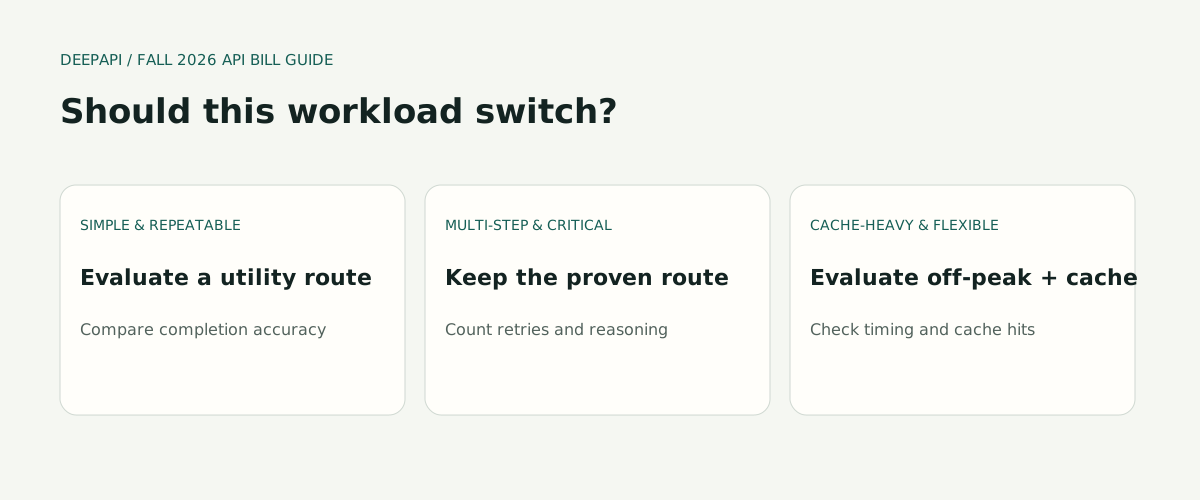
- You Run Asynchronous, Batch, or Off-Hours Pipelines: If your systems ingest documents, build vector embeddings, or execute overnight ETL operations, move work to DeepSeek off-peak windows or schedule them against GPT-5.6 Luna. A 1M/1M batch on DeepSeek V4 Flash during off-peak windows costs a fraction of any mid-tier model.
- Your Pipelines Enjoy Heavy Prompt Caching: If your architecture consistently prepends large static contexts (such as massive codebase indices, API schemas, or legal rulebooks), DeepSeek’s V4 Pro cache-hit price ($0.022/1M off-peak, $0.044/1M peak) offers immense savings over un-cached frontier inference.
- Your Tasks Consist of Well-Defined Single-Turn Operations: Routing straightforward tasks like categorization, JSON reformatting, sentiment scoring, and basic translation to GPT-5.6 Sol or Claude Opus is capital destruction. Shift these workloads immediately to Luna, V4 Flash, or Gemini 3.7 Flash (which holds its $0.75 / $3.75 introductory rate card through December 31, 2026).
- You Can Buffer Against Occasional Latency Spikes: If your customer-facing product tolerates asynchronous delivery or features defensive retry queues, routing through vetted secondary infrastructure can capture substantial unit-economics advantages.
Who Should Stay?
Conversely, chasing headline price drops can easily backfire. Maintain your current tier or stay routed to frontier foundation models under the following conditions:
- Your Tasks Involve Complex Autonomous Agent Loops: When building recursive agents that write code, test terminal output, and self-correct, reasoning degradation introduces massive compounding costs. A cheaper utility model that hallucinates on step four will burn thirty additional tool calls trying to recover. Staying on GPT-5.6 Sol or Claude Opus yields a lower total cost per task.
- You Require Predictable SLA and Strict Concurrency Guarantees: Mission-critical production applications operating during European and North American daytime overlap directly with DeepSeek’s second peak window (06:00–10:00 UTC). If paying 4.6× standard output rates or experiencing queue throttling threatens your business operations, direct contract arrangements with OpenAI or Anthropic provide superior baseline stability.
- You Operate Under Strict Data Residency and Compliance Constraints: Direct provider agreements, dedicated endpoints, and established SOC 2 / HIPAA compliance perimeters frequently outweigh the marginal savings of moving workloads across un-audited third-party proxy bridges.
- Your Text Payloads Are Tokenizer-Sensitive: Upgrading across model generations requires measuring output volume. For instance, because Claude 4.7+ tokenizers can yield roughly 30% more tokens on identical raw English text than competing tokenizers, a lower headline rate card does not always equal an identical reduction in your gross month-end invoice.
Token Price Is Not Your Bill: The Price Reversal Reality
The most hazardous trap in AI API pricing 2026 is treating listed token rates as the sole determinant of your final spend.
In real-world deployment, empirical research conducted by institutions including Microsoft Research, UC Berkeley, and Stanford identified the price reversal phenomenon: in approximately 32% of head-to-head model comparisons, the model featuring the cheaper posted rate card proved more expensive to execute in production. In extreme outlier cases, the nominally cheaper model racked up invoices up to 28× higher.
┌────────────────────────────────────────────────────────────────────────┐
│                        THE PRICE REVERSAL TRAP                         │
├────────────────────────────────────────────────────────────────────────┤
│ Nominal Rate Card:                                                     │
│ Model A (Utility Tier):  $0.20 in / $1.20 out                          │
│ Model B (Frontier Tier): $2.00 in / $10.00 out                         │
│                                                                        │
│ Production Reality on Multi-Step Reasoning:                            │
│ Model A generates 4,500 internal thinking tokens + 2 retry loops       │
│ Model B generates 400 direct output tokens + 0 retries                 │
│                                                                        │
│ Result: Model A's realized task cost outstrips Model B.                │
└────────────────────────────────────────────────────────────────────────┘
The primary engine behind this pricing reversal is internal reasoning and chain-of-thought token generation. Models that produce extensive hidden thinking tokens before emitting their first visible character quickly erase nominal token discounts. Studies indicate that removing internal reasoning tokens accounts for roughly 70% of the observed price reversal effect. Our comprehensive review on the price reversal phenomenon unpacks the mathematical drivers behind this divergence.
Before modifying your global production routing rules, follow this systematic evaluation protocol:
- Build a Standardized Evaluation Benchmark: Assemble an automated test harness containing 50 to 100 representative prompts reflecting your team's exact production tasks (including edge cases and tool-use schemas).
- Log Gross Task Invoices, Not Just Token Counts: Record execution latency, total hidden thinking tokens, retry frequency, and complete cost per successful completion.
- Audit Upstream Memory Constraints: Factor in latency and memory bandwidth limitations on dense models by checking our memory wall and AI inference analysis.
- Deploy Phased Canary Routing: Direct 5% of internal non-critical workloads to your prospective lower-tier endpoint. Verify that downstream task completion metrics remain steady over a full 48-hour cycle before shifting production traffic.
OpenRouter and Gateway Risk
Third-party model routers and API aggregators have emerged as a popular mechanism to exploit rate differentials. As documented in our survey on AI price arbitrage across third-party providers, third-party providers frequently undercut direct provider pricing by 30% to 92% by leveraging volume discounts, wholesale capacity commitments, and regional hardware arbitrage.
However, infrastructure centralization introduces new considerations. On August 16, 2026, Stripe finalized its acquisition of OpenRouter for over $7 billion, bringing an aggregation network serving over 8 million developers and routing across hundreds of models under corporate ownership (as reported in our market update tracking the acquisition).
While an intelligent gateway offers elegant multi-provider failover, buyers must balance structural tradeoffs:
- The Intermediation Cut: Gateways typically take an estimated ~5% margin on managed inference spend.
- Platform Concentration Risk: Relying on a single gateway creates a central point of failure for authentication, credit balances, and network routing.
- Latency Variance and Data Policies: Independent aggregators report varying uptime records, higher p99 latency dispersion, and differing data retention guarantees compared to direct Tier-1 cloud endpoints.
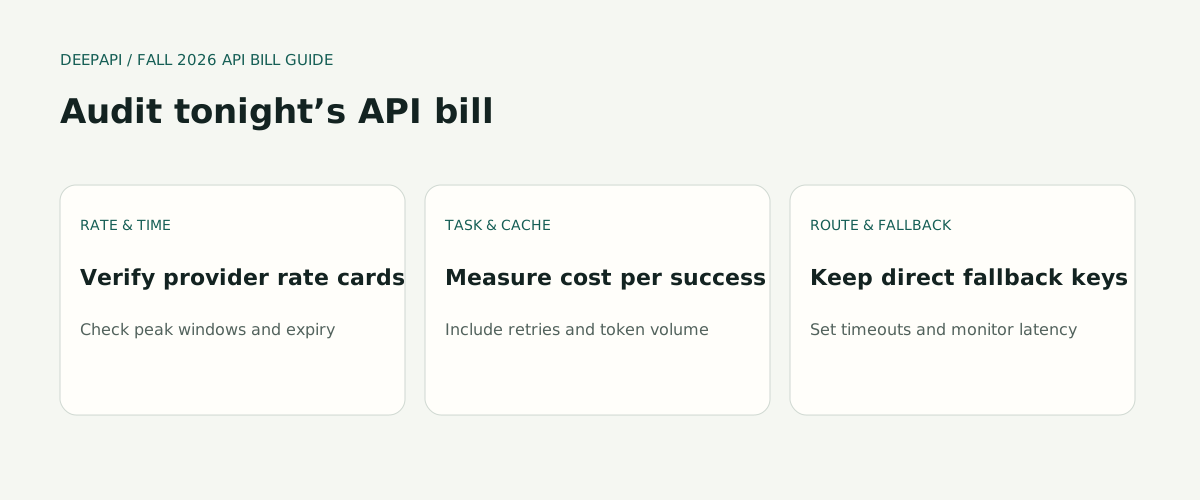
For high-volume engineering organizations, maintain direct fallback API keys within your SDK client so traffic fails over automatically if any intermediary gateway suffers an outage.
Tonight’s Bill Checklist
Before deploying updates or committing to next month’s inference budget, run your architecture through this practical, nine-point audit:
- Map Your DeepSeek Call Windows: Verify whether your primary traffic triggers DeepSeek’s peak hours (01:00–04:00 and 06:00–10:00 UTC). If possible, shift batch ingestion jobs to off-peak slots to cut output rates by half.
- Split Ingestion from Reasoning: Audit whether data preprocessing, JSON extraction, or summarization tasks are still hitting GPT-5.6 Sol or Claude Opus. Reroute basic utility workloads to GPT-5.6 Luna or DeepSeek V4 Flash.
- Audit Cache-Hit Efficiencies: Confirm that your API wrappers take advantage of prompt caching mechanisms. If your system prompts exceed 2,000 tokens, failure to hit cache endpoints leaves massive savings on the table.
- Verify Live Provider Rate Cards: Inspect our live Model API Price index to ensure your billing models reflect the latest pricing updates rather than outdated rate sheets.
- Check Introductory Expiration Dates: Note that Gemini 3.7 Flash introductory rates ($0.75 / $3.75 per 1M) expire on December 31, 2026, doubling to $1.50 / $7.50 on January 1, 2027. Adjust Q1 budgets accordingly.
- Validate Sonnet 5 Invoicing: Confirm your billing dashboard reflects Anthropic’s permanent $2.00 / $10.00 standard rate rather than superseded placeholder estimates.
- Measure Cost Per Task, Not Token Cost: Calculate total spend divided by successful completions across your evaluation suite to safeguard against the price reversal phenomenon.
- Configure Gateway Fallback Routes: If routing through OpenRouter or secondary third-party providers, ensure client-side timeout configurations cleanly fail over to direct official endpoints.
- Review API vs. Subscription Break-Evens: For solo developers and small agent teams, review our Subscriptions hub to determine whether unlimited interface tiers represent better value than raw API token spend.
Frequently Asked Questions
After Luna’s cut and DeepSeek peak pricing, how should I pick my API bill in fall 2026?
Focus on total task cost rather than headline token rates. Route low-complexity, high-volume workloads to utility tiers like GPT-5.6 Luna or Gemini 3.7 Flash. Direct complex reasoning and recursive agents to Claude Sonnet 5, Claude Opus 5, or GPT-5.6 Sol. If using DeepSeek, schedule batch jobs during off-peak hours to avoid the 2× peak pricing multiplier.
Is the cheapest listed $/1M tokens always the cheapest bill?
No. Empirical studies demonstrate that in roughly 32% of head-to-head model comparisons, nominally cheaper models end up more expensive in production. This occurs because cheaper utility models often require multiple retry attempts, generate verbose internal reasoning tokens, or require broader prompt engineering to complete complex assignments successfully.
Who should move high-volume work to Luna-class utility tiers?
Engineering teams running document extraction, high-frequency classification, simple embeddings, vector indexing, or initial user query triage should transition to Luna-class tiers immediately. These tasks do not require advanced frontier reasoning, allowing teams to fully capture the ~80% price reduction without compromising output accuracy.
Who should stay on Sol / Opus / Mythos-class premium?
Teams operating high-stakes autonomous agents, multi-step code refactoring tools, legal/medical compliance engines, or critical production environments with strict zero-failure tolerances should stay on premium models. In these scenarios, the cost of failed agentic loops or downstream hallucinations vastly outweighs marginal token savings.
How do DeepSeek peak vs off-peak hours change real cost?
DeepSeek’s peak hours run daily from 01:00–04:00 and 06:00–10:00 UTC. During these windows, input and output rates double compared to off-peak rates. For example, DeepSeek V4 Pro output jumps from $1.98 per million tokens off-peak to $3.96 during peak hours. Running batch workloads exclusively in off-peak windows cuts execution costs by 50%.
Should I route through OpenRouter or another gateway after the Stripe deal?
Using an aggregator remains highly effective for rapid prototyping and multi-model fallbacks. However, with Stripe finalizing its $7B+ acquisition of OpenRouter, buyers should account for the ~5% platform fee on inference spend and implement direct provider API keys as automatic fallbacks to protect against latency spikes and outages.
Where do I check live rates on Deepapi?
You can track real-time pricing across official providers and third-party hosters directly on our Model API Price directory at https://deepapi.app/model-api-price. For continuous updates on tier launches, rate shifts, and availability warnings, monitor our daily Today stream at https://deepapi.app/today.
Token price vs task price — which should I optimize?
Always optimize for task price. A model charging $0.20 per million input tokens that requires three retries and 4,000 reasoning tokens costs significantly more per delivered result than a $2.00 model that solves the problem correctly on the first attempt with 300 output tokens.
The Bottom Line for Fall 2026
The AI API price wars of summer 2026 demonstrated that raw model intelligence is bifurcating. The bottom tier has transformed into an aggressive commodity utility, while frontier reasoning retains premium pricing. Success in fall 2026 does not come from chasing the loudest price-drop headline—it comes from architecting a dynamic routing stack that executes tasks at the right capability tier, during the optimal hour, with validated prompt caches.
Follow the thread to your next practical buying question by consulting our directory on Model API Price, checking verified market shifts on Today, or diving into our complete collection of AI buying guides.
Current prices are on the price table.
Related
- 2026-11-02 · Fall 2026 Subscription Bill: One $20, a $40 Stack, or Graduate to Max/Pro?
- 2026-08-20 · The August 2026 Pricing Storm: DeepSeek's 4x Hike, Gemini's Clock, and the End of Flat API Pricing
- 2026-08-19 · The AI Price War Just Got a Scoreboard: Luna Down 80%, Opus 5 at Half Price, and Token Spend Is Moving
- 2026-06-29 · The Price Reversal Phenomenon: When Cheaper AI Models Cost More