2026-11-02Compare
Fall 2026 Subscription Bill: One $20, a $40 Stack, or Graduate to Max/Pro?
Open your credit card statement or head to Settings → Billing across your active AI platforms this fall, and the monthly line items add up fast. What started a couple of years ago as a straightforward decision to pay for a single $20 tier has quietly morphed into a complicated, multi-tiered maze. Many developers, analysts, and founders now ask whether one $20 seat is enough, whether subscription stacking two tools into a $40 combo makes financial sense, or whether it is finally time to graduate into enterprise-heavy tiers like Claude Max or ChatGPT Pro.
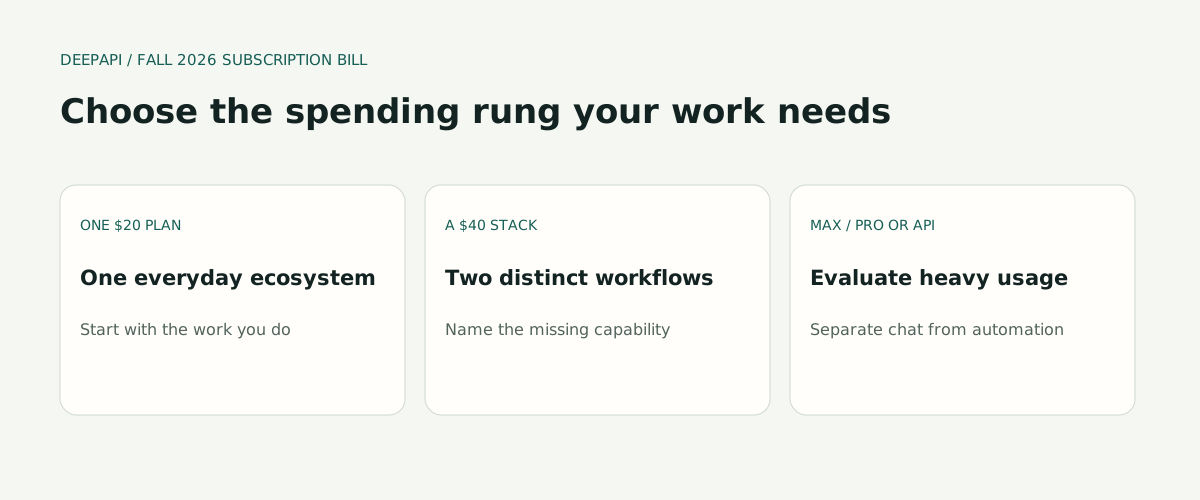
Evaluating your subscription bill in fall 2026 is no longer about arguing over which frontier model achieved a fractional benchmark lead. The real buying question is operational: Which specific spending rung matches your actual weekly throughput, multi-modal needs, and message caps without wasting recurring software spend?
Rather than rehashing standalone tool reviews, this guide establishes a clear, laddered decision framework. If you need granular pairwise teardowns, read our dedicated reviews on choosing the best AI subscription under $20 and comparing ChatGPT Plus vs Claude Pro. For those running autonomous coding agents or high-volume background pipelines, cross-reference our companion guide on optimizing your fall 2026 API bill. Here is how to configure your subscription stack tonight.
| Rung | Typical Monthly Spend | What You Get | Best For | Graduate When... |
|---|---|---|---|---|
| Rung 1: Single $20 Plan | $20/mo (or ~$17/mo billed annually for Claude) | Full access to one flagship ecosystem: ChatGPT Plus ($20), Claude Pro ($20), or Google AI Pro ($19.99 with 2TB storage) | Solo knowledge workers, generalist writers, everyday coding help | You routinely hit 5-hour rate limits or need complementary features (e.g., deep voice mode + long-context artifact editing). |
| Rung 2: The $40 Stack | $40/mo | Dual flagship access: typically ChatGPT Plus paired with Claude Pro or Perplexity Pro | Power users requiring cross-model verification, specialized coding sidecars, and uninterrupted daily continuity | You burn through combined limits on complex projects, or you need integrated programmatic allowances. |
| Rung 3: High-Usage Tiers (Max & Pro) | $100 to $200/mo (up to $500/mo for legacy power pools) | 5× to 10× baseline usage caps; bundled API credits (Claude Max/Ultra); priority compute on demanding reasoning modes | Full-time professional software engineers, dedicated researchers, high-throughput content desks | Your work shifts from interactive chat sessions to automated terminal agents, multi-file codebases, or asynchronous batch jobs. |
| Rung 4: The Direct API & Router Path | Usage-based pay-as-you-go (often $15 to $80/mo) | Zero monthly platform lock-in; granular per-token billing; automated failover and caching across hundreds of open and closed models | Developers running customized coding agents, CLI tools, automated document pipelines, or off-peak scheduled jobs | Interactive conversational interfaces, voice assistants, and native ecosystem canvas tools are required daily. |
Fall 2026 Subscription Bill Ladder at a Glance
The table below outlines the four primary budget tiers available to buyers in late 2026. Baseline figures reflect standard consumer rate cards as documented across our comparative guides (updated September 13, 2026) and verified against official provider pricing pages as of November 2, 2026.
To inspect real-time pricing, promotional offers, and third-party hosting rates, cross-reference our live Subscriptions hub and the Model API Price index.
Stay on One $20 Plan: The Generalist Baseline
For a substantial majority of independent knowledge workers, maintaining a single $20 subscription remains the most rational financial baseline.
As documented in our baseline study on the best AI subscription under $20, jumping prematurely to multiple services often creates redundant overhead. If your daily workflow consists of drafting correspondence, querying technical documentation, generating occasional marketing concepts, and analyzing spreadsheets, one flagship consumer seat covers your baseline comfortably.
┌────────────────────────────────────────────────────────────────────────┐
│                   THE SINGLE $20 DECISION FILTER                       │
├────────────────────────────────────────────────────────────────────────┤
│ • Do you hit your plan's message cap more than twice a week?           │
│   NO ──► Stay on your single $20 plan.                                 │
│                                                                        │
│ • Can you name a specific, recurring task your current model fails at? │
│   NO ──► Stay on your single $20 plan.                                 │
│                                                                        │
│ • Do you actively require specialized tools from two distinct clouds? │
│   NO ──► Stay on your single $20 plan.                                 │
└────────────────────────────────────────────────────────────────────────┘
Which $20 Plan Is Your Default?
- The Generalist Anchor (ChatGPT Plus - $20/mo): Remains the safest all-in-one default. It bundles advanced conversational voice mode, native DALL-E image generation, structured canvas editing, and custom GPT workspace tools into a cohesive package.
- The Specialist Alternative (Claude Pro - $20/mo): If your primary workload centers on long-form document synthesis, nuanced prose style, complex architectural logic, and multi-file code refactoring, Claude Pro’s structured artifact interface makes it a formidable single choice. (Diners can capture modest savings via Claude’s annual billing option, which prices out at $17/mo billed up front).
- The Ecosystem Alternative (Google AI Pro - $19.99/mo): Ideal for users whose daily work lives inside Google Workspace (Docs, Gmail, Drive) and who value the included 2TB cloud storage allotment alongside Gemini models.
When to stay: Keep your setup locked to one $20 plan if you rarely encounter rate limits, do not require simultaneous real-time voice and deep reasoning tools, and do not spend your entire working day running recursive code refactoring.
When a $40 Stack Pays for Itself
The leap from a single subscription to a $40 dual stack is the most widely debated transition in personal productivity software. Adding a second subscription should never be an emotional hedge against FOMO (fear of missing out). It is a calculated business investment that must justify its cost against billable hours.
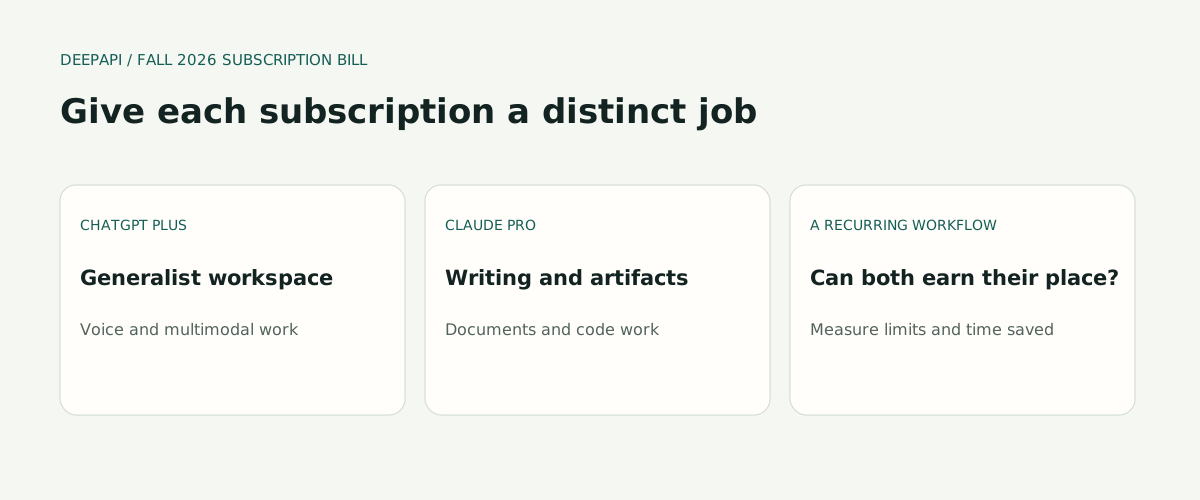
As established in our ChatGPT Plus vs Claude Pro analysis, a $40 stack is strictly justified when you meet one or more of these four operational criteria:
- You Routinely Hit Mid-Day Usage Limits: If your productivity grinds to a halt because you burn through Claude Pro’s standard message allocation (historically around ~45 messages per 5-hour rolling window on demanding models) or exhaust your ChatGPT Plus deep research and high-reasoning query allotments, waiting for the rate-limit window to reset costs significantly more in downtime than $20 a month.
- Your Stack Requires Two Irreplaceable Feature Sets: No single provider excels at every modality. If you rely on ChatGPT Plus for its hands-free conversational voice mode and web browsing, but simultaneously require Claude Pro’s Projects folder and artifact rendering for client-facing software delivery, maintaining both accounts is a functional necessity.
- You Require Independent Model Verification: For legal professionals, financial analysts, and software architects, running critical code snippets or complex contractual interpretations through two independent model architectures eliminates blind spots and hallucinations before client delivery.
- The Time-to-ROI Equation Closes in One Hour: If having an immediate backup subscription saves you even thirty to forty-five minutes of stalled work each month, the secondary $20 expense pays for itself immediately against your effective hourly billing rate.
The Proven $40 Combos:
- The Builder Stack ($40/mo): ChatGPT Plus + Claude Pro. Combines universal multimodal versatility with elite code reasoning and contextual writing depth.
- The Research Stack ($40/mo): ChatGPT Plus + Perplexity Pro. Combines conversational ideation and creative execution with indexed, citation-backed web research.
Graduate to Max or ChatGPT Pro
When your daily computational demands overwhelm standard consumer rate limits, stacking three or four separate $20 accounts becomes messy, fragmented, and counterproductive. At this juncture, the smart play is to graduate to higher-tier enterprise-grade plans like Claude Max or ChatGPT Pro.
┌───────────────────────────────────────┬───────────────────────────────────────┐
│        High-Usage Tier Feature        │         How It Changes the Math       │
├───────────────────────────────────────┼───────────────────────────────────────┤
│ 5× to 10× Usage Multipliers           │ Eliminates daily midday lockouts      │
│ Bundled Monthly API Credits           │ Bridges interactive chat and CLI tools│
│ Dedicated Compute Queues              │ Bypasses peak-hour latency throttling │
│ Priority Reasoning Allocations        │ Runs deep chain-of-thought uninterrupted│
└───────────────────────────────────────┴───────────────────────────────────────┘
The Claude Max & Ultra Proposition
Official rate cards (verified November 2, 2026 on Claude Pricing) illustrate how Anthropic structured its premium tiers to serve dual-track power users:
- Claude Max ($100/mo): Delivers roughly 5× the standard Pro usage allocation across both 5-hour and weekly windows. Crucially, it includes $100 a month in API credits usable across the Claude developer platform.
- Claude Ultra ($200/mo): Extends throughput to approximately 10× Pro weekly usage, removes the 5-hour messaging throttle for verified accounts, and includes $200 a month in API credits.
This pricing design fundamentally shifts the subscription versus API equation. If your engineering workflow already consumes $100 to $200 monthly running automated testing scripts, Claude Code terminal utilities, or internal documentation parsers via developer keys, upgrading to Max or Ultra effectively renders the high-limit web interface free of charge.
The ChatGPT Pro Dynamic
On the OpenAI side of the ledger, stepping up to ChatGPT Pro ($200/mo) targets specialized users requiring unlimited high-speed access to advanced reasoning models, prioritized computational capacity, and expanded execution environments like Codex.
As detailed in our breakdown of ChatGPT Pro $500 vs $200, buyers must monitor their consumption carefully. If your daily coding tasks barely register on your workspace usage bars, staying locked at $200 is sufficient; moving to higher enterprise pools should only occur when mission-critical team workloads hit hard resource ceilings. Furthermore, as explored in our evaluation of ChatGPT Space: Plus or Pro, avoid upgrading your account solely to access novel canvas or workspace UI features if your primary document drafting still lives inside Notion or Google Docs.
Stop Stacking: When to Move Spend to API
There arrives a distinct inflection point where stacking consumer subscriptions becomes an inefficient way to buy machine intelligence. When your work shifts from interactive conversational sessions to programmatic execution, paying flat consumer subscription fees is often the wrong financial choice.
Why Developers Migrate to Pay-Per-Token
- Low Idle Overhead: A $20 consumer subscription costs $20 whether you submit five prompts or five hundred. If your usage is highly variable—heavy during weekend development sprints but silent during client review weeks—paying per million tokens via direct endpoints aligns costs strictly with production value.
- Access to Aggressive Commodity Price Drops: Over summer 2026, utility-tier pricing plummeted. As detailed in our companion analysis on fall 2026 API bills, OpenAI's 80% price reduction on GPT-5.6 Luna ($0.20 input / $1.20 output per 1M tokens) and DeepSeek’s dynamic off-peak scheduling mean background document processing and code reviews run for pennies when routed through developer endpoints.
- Unified Model Routers and Gateways: Utilizing multi-provider aggregators like OpenRouter allows developers to access hundreds of open-weight and proprietary models through a single balance. While gateways introduce minor platform fees (such as OpenRouter's 5.5% standard credit purchase fee, detailed on OpenRouter Pricing), they provide automated failover, BYOK (bring-your-own-key) options, and unified billing across diverse provider architectures.
When to ditch the stack for an API key: If your primary interface is a code editor plugin (like Cursor or Continue), a terminal coding agent, or an internal data automation script, cancel your secondary consumer subscription and load $25 into a flexible API gateway balance instead.
Tonight’s Subscription Bill Checklist
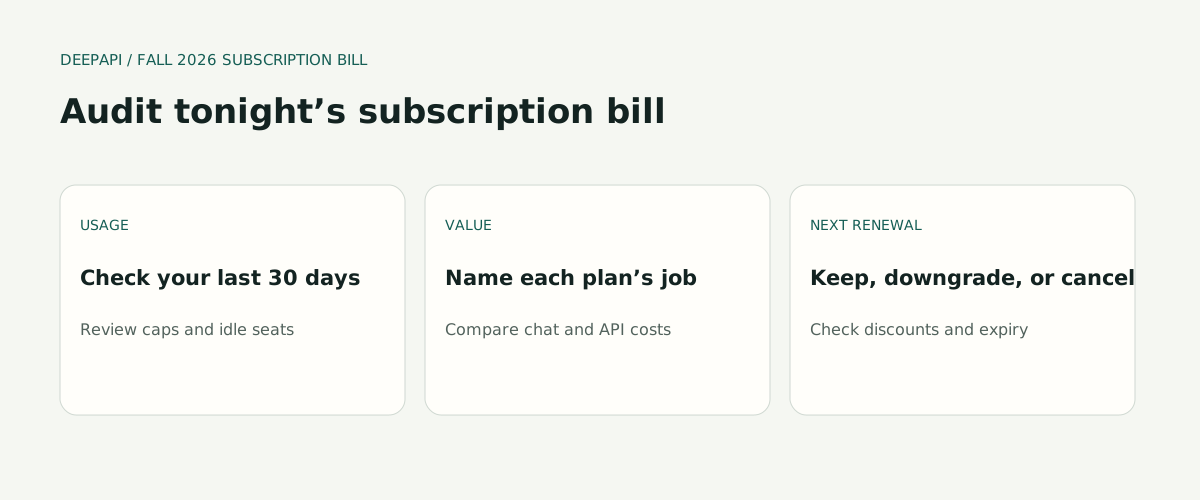
Before your recurring credit card billing cycles renew this week, run your accounts through this nine-point audit:
- Audit Your 30-Day Usage History: Open each provider's usage tab. Did you actually trigger a rate-limit barrier or hit a 5-hour message cap during the past month? If not, downgrade secondary subscriptions immediately.
- Identify the Missing Workflow: Can you articulate the exact, uncompromised workflow that your primary $20 plan cannot execute? If your answer is vague, cancel your second subscription.
- Leverage Annual Billing Discounts: If Claude Pro is your verified daily driver, switch from the $20 monthly plan to the $200 annual option to reduce your annualized cost to roughly $17/mo.
- Check Bundled API Credit Utilization: If you subscribe to Claude Max ($100/mo) or Ultra ($200/mo), verify that your engineering team is actively drawing down the bundled $100 or $200 monthly developer API credits. Unused credits represent pure wasted budget.
- Audit Pro Workspace Gauges: If you are paying for ChatGPT Pro ($200/mo), check whether your weekly compute utilization exceeds 50% of your allocated tier. If you are solely using standard chat interfaces, drop back to Plus.
- Avoid Feature-Hype Upgrades: Do not upgrade subscription tiers solely to access preview UI modes like ChatGPT Space or Gemini Ultra experimental features. As highlighted in our review of Gemini 4 Argon Pro and Ultra, evaluate tools on your current billable output, not marketing roadmaps.
- Check Live Rate Cards on Deepapi: Visit our Subscriptions hub and Model API Price directories to verify whether current promotional deals or tier updates impact your subscriptions.
- Verify Promotional Deal Expirations: If your account is running on introductory educational or platform promotional codes, check our Deals index to prepare for upcoming price resets.
- Separate Terminal Agents from Chat Accounts: If you are using third-party coding extensions in your IDE, verify that they are running against low-cost utility API endpoints rather than burning premium consumer seat allowances.
Frequently Asked Questions
In fall 2026, should I stay on one $20 plan, stack to $40, or graduate to Max/Pro?
Start with a single $20 plan such as ChatGPT Plus or Claude Pro. Only stack to a $40 combination if you routinely hit 5-hour usage caps or require complementary multimodal tools like voice mode paired with long-form artifact editing. Graduate to Max ($100/mo) or ChatGPT Pro ($200/mo) if you require 5x to 10x throughput and can actively utilize bundled monthly API credits for development workflows.
When is a second $20 subscription worth it?
A second $20 subscription pays for itself when rate limits actively interrupt billable work, when you require independent cross-model verification for high-stakes analysis, or when you need specialized tools from two distinct platforms such as web research via Perplexity Pro and artifact code editing via Claude Pro.
When is Max or ChatGPT Pro a better move than stacking two consumer plans?
High-usage tiers become superior when multiple team members share a research seat, when you need uninterrupted continuous reasoning during heavy work sprints without 5-hour throttles, or when you take full advantage of the bundled developer API credits included with tiers like Claude Max ($100/mo in credits) and Ultra ($200/mo in credits).
How do Claude Max/Ultra monthly API credits change the subscription vs API math?
Because Claude Max ($100/mo) includes $100 in monthly API credits and Claude Ultra ($200/mo) includes $200 in credits, developers who already spend money on Anthropic's API platform effectively receive high-usage web access, expanded message windows, and priority compute at zero net additional cost.
When should I stop stacking subscriptions and put budget into API / a router instead?
Transition spend to direct API endpoints or an aggregator like OpenRouter when your work shifts from human-driven chat sessions to automated background pipelines, CLI tools, IDE coding extensions, or scheduled batch jobs. Pay-as-you-go token pricing eliminates recurring seat waste and captures significant cost savings on utility models.
Which single $20 plan is the safest default for generalists?
ChatGPT Plus ($20/mo) remains the safest baseline default for generalists due to its well-rounded integration of multimodal capabilities, including advanced voice conversation, custom GPTs, integrated image generation, web search, and structured canvas workspaces.
Where do I check live subscription and API prices on Deepapi?
You can review up-to-date consumer tier pricing, platform allowances, and features directly on our Subscriptions hub at https://deepapi.app/subscriptions. To compare raw token prices, caching discounts, and provider arbitrage, visit our Model API Price catalog at https://deepapi.app/model-api-price.
How does this guide relate to the fall 2026 API bill framework?
This buying guide focuses on fixed monthly consumer and professional subscription seats ($20 to $200+ per month). Our companion fall 2026 API bill framework focuses on variable token-based infrastructure costs, covering utility rate cuts, peak/off-peak scheduling, prompt caching efficiencies, and the price reversal phenomenon.
The Bottom Line on Tonight’s Bill
Optimizing your AI subscription bill in fall 2026 is an exercise in ruthless alignment. Collecting multiple $20 subscriptions like streaming services provides an illusion of capability while draining productivity budgets.
Begin on a single $20 foundation that handles eighty percent of your daily needs. Only deploy a $40 dual stack when you can explicitly name the missing workflow causing operational friction. If your workload explodes into enterprise territory, evaluate tiers like Claude Max or ChatGPT Pro based on their bundled API credits and uncapped compute pools. And when your work becomes fully automated, leave subscriptions behind and let direct API endpoints carry the load.
Follow the thread to your next buying decision by auditing current platform tiers on our Subscriptions hub, exploring developer token rates on Model API Price, or browsing our full library of independent AI buying guides.
Current prices are on the price table.
Related
- 2026-11-02 · ChatGPT Pro After the Double: Keep $100, Stay at $200, or Still Jump to $500?
- 2026-06-29 · One $20 or Two $40? The AI Subscription Stacking Debate (2026)
- 2026-10-26 · After Luna’s 80% Cut and DeepSeek Peak Pricing: How to Pick Your API Bill in Fall 2026
- 2026-06-29 · ChatGPT Plus vs Claude Pro (2026): Same $20, Radically Different Tools