2026-11-02Compare
ChatGPT Pro After the Double: Keep $100, Stay at $200, or Still Jump to $500?
If you opened your billing dashboard in late October, you were likely bracing for a painful haircut. For weeks, engineering teams and autonomous developers using ChatGPT Pro operated under the threat of a looming deadline: an October 29 cutoff where Pro 200 accounts faced steep usage reductions. Instead, OpenAI reversed course. On October 29, OpenAI officially doubled the shared Work and Codex allowance across multiple tiers, cancelled the planned reduction on the $200 tier, and expanded limits for Pro 100 subscribers.
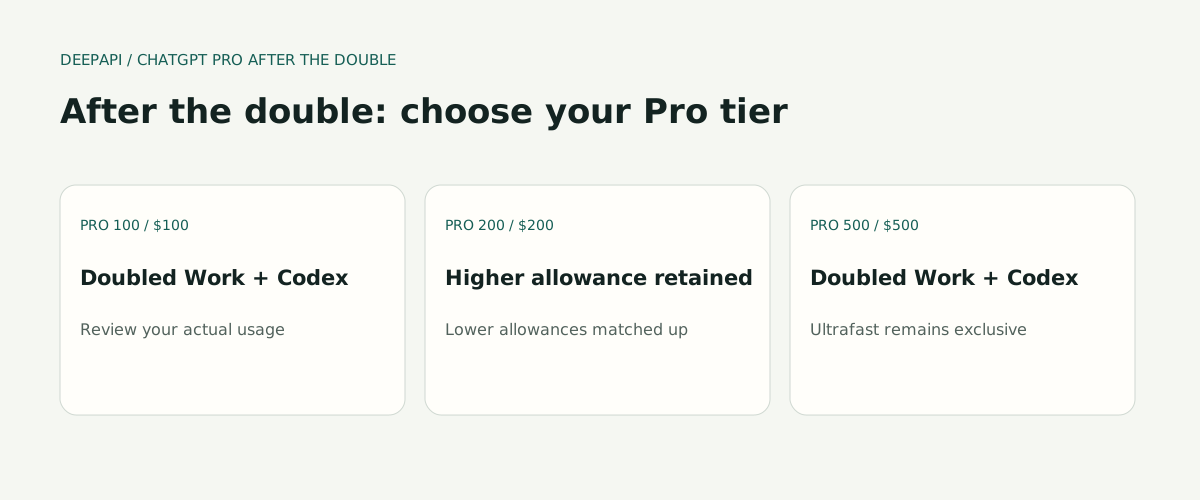
This abrupt policy reversal completely upends your tonight’s Pro bill. The core purchasing question is no longer how to defensively hoard legacy capacity before a deadline. The practical decision facing buyers in fall 2026 is simple: Now that the baseline has expanded, can you comfortably step down to $100, should you maintain your $200 seat, or do you still need to pay $500 for high-compute headroom?
To make a rational call, you must first understand what actually changed on the consumer platform. This guide evaluates the refreshed tiers of consumer ChatGPT Pro—not the OpenAI developer API rate cards. If you are comparing lower-priced consumer entry points, read our companion analysis on the fall 2026 subscription bill ladder or our guide on choosing an AI subscription under $20. If you are looking at prior grace-period assumptions, cross-reference our pre-double analysis of ChatGPT Pro $500 vs $200. Here is how to audit your seat tonight.
| Plan | Monthly Price | What Changed on Oct 29 | Ultrafast Access | Best For | Reconsider When... |
|---|---|---|---|---|---|
| ChatGPT Plus | $20/mo | Unchanged (No quota increase; baseline chat & canvas) | No | Solo generalists, basic document drafting, light coding | You hit weekly reasoning limits or need multi-file agent execution. |
| Pro 100 | $100/mo | Doubled Work & Codex allowance; standard weekly chat caps | No (Purchased credits will not unlock it) | Independent developers and analysts running daily automated scripts | You consistently drain your monthly allowance before the final week. |
| Pro 200 | $200/mo | Cut canceled; lower allowances doubled to match the higher tier | No | Heavy full-time software engineers and quantitative researchers | Pro 100’s doubled capacity leaves your monthly usage bar below 40%. |
| Pro 500 | $500/mo | Doubled Work & Codex allowance; highest included throughput | Yes (Exclusive access to Ultrafast execution) | Elite engineering teams, high-stakes founders, zero-latency workflows | You rarely trigger Ultrafast mode and only run standard scripts. |
| Direct API Route | Pay-as-you-go per token | Direct infrastructure pricing; dynamic off-peak scheduling | Model-dependent | Headless background scrapers, CI/CD pipelines, custom autonomous agents | You require native canvas workspaces, voice mode, and bundled consumer UIs. |
What Actually Doubled on October 29?
When headlines proclaimed that OpenAI "doubled Pro limits," many subscribers assumed their entire account throughput doubled across the board. The operational reality detailed on OpenAI's official About ChatGPT Pro Tiers help page is far more nuanced.
┌────────────────────────────────────────────────────────────────────────┐
│                   THE OCTOBER 29 PRO RESET AT A GLANCE                 │
├────────────────────────────────────────────────────────────────────────┤
│ • Work and Codex Allowance: DOUBLED on Pro 100 and Pro 500.           │
│ • Pro 200 Protection: Planned cut canceled; lower tiers matched.       │
│ • Weekly Chat Message Limits: Separate bucket; Pro 200 aligned.        │
│ • Standard ChatGPT Plus ($20/mo): UNCHANGED (no quota increase).       │
│ • Ultrafast Reasoning Mode: Remains strictly exclusive to Pro 500.     │
└────────────────────────────────────────────────────────────────────────┘
1. Work & Codex Allowances Expanded
The primary engine of the October 29 update is the shared Work and Codex allowance—the consumption pool that powers automated IDE tasks, terminal scripting, deep workspace document synthesis, and background file manipulation.
- Pro 100 ($100/mo) and Pro 500 ($500/mo) now include twice their previous Work and Codex allowance.
- For Pro 200 ($200/mo), users who previously received the lower allowance had their capacity doubled to match the higher allocation, while existing high-allowance subscribers kept their grandfathered ceiling intact. The reduction originally announced in late September was formally rescinded.
- Business Premium accounts were also named in public announcements by leadership (such as product lead Thibault Sottiaux) as receiving doubled capacity, though per-seat absolute metrics are managed directly through enterprise contracting rather than public consumer rate cards.
2. Standard Chat Limits vs. Work & Codex
Crucially, your account operates with two distinct enforcement mechanisms:
- The Shared Work and Codex Pool: Measured by dynamic resource consumption during complex agentic and code operations.
- Weekly GPT-6 Pro Message Limits: Governs standard conversational messaging in the chat window.
For Pro 100 and Pro 500, weekly chat message limits remained at their existing levels. For Pro 200, users who were on lower message limits were aligned upward with the higher standard. Standard Plus ($20/mo) received zero increases to its allowances.
3. The Crucial Caveat: Larger Allowance ≠ Twice the Tasks
OpenAI explicitly published a vital warning for enterprise buyers: The amount of work you can complete still depends on the model, task, and settings. A larger allowance does not guarantee twice as many completed tasks.
Resource consumption scales aggressively when using heavy reasoning settings. According to official Help documentation, running tasks in Fast mode consumes approximately 2.5× the included allowance of Standard mode on the same model. Selecting Ultrafast (such as GPT-6 Astra or GPT-6.1 Sol) consumes a massive 8× the included allowance of Standard execution. If your team toggles into high-speed reasoning modes, even a doubled allocation can evaporate over an intensive two-day sprint.
Post-Double Ladder at a Glance
The table below breaks down the consumer ChatGPT tiers following the October 29 adjustments. Figures and tier conditions are verified against official Help documentation as of November 2, 2026.
To monitor live platform rates, enterprise seat structures, and model comparisons, inspect our ChatGPT subscription profile and the Model API Price index.
Keep Pro 100 ($100): The New Sweet Spot?
Prior to October 29, the $100 tier often felt like an awkward middle ground. It cost five times as much as ChatGPT Plus but carried strict enough constraints that heavy developers felt pushed directly into Pro 200.
Following the doubling of the Work & Codex allowance, Pro 100 emerges as the most cost-effective tier for professional solo operators.
Who Should Stay on (or Drop Down to) Pro 100?
- You Run Targeted Daily Coding Sprints: If you use the Codex CLI or ChatGPT Work extension to generate unit tests, refactor legacy functions, or parse API documentation a few times a day, the expanded allowance provides substantial breathing room.
- You Do Not Require Ultrafast Compute: Ultrafast is locked exclusively to Pro 500. If you are satisfied with Standard and Fast execution speeds, paying an extra $100 each month simply for excess headroom you never burn is a waste of budget.
- Your Extended Limits for Dots Remain Active: As noted by OpenAI leadership during the announcement, extended limits for experimental interfaces like dots continue for now. If you were testing advanced workflows without hitting caps, Pro 100 handles the load. (For context on experimental interfaces, see our review of OpenAI Dots vs Meta Muse).
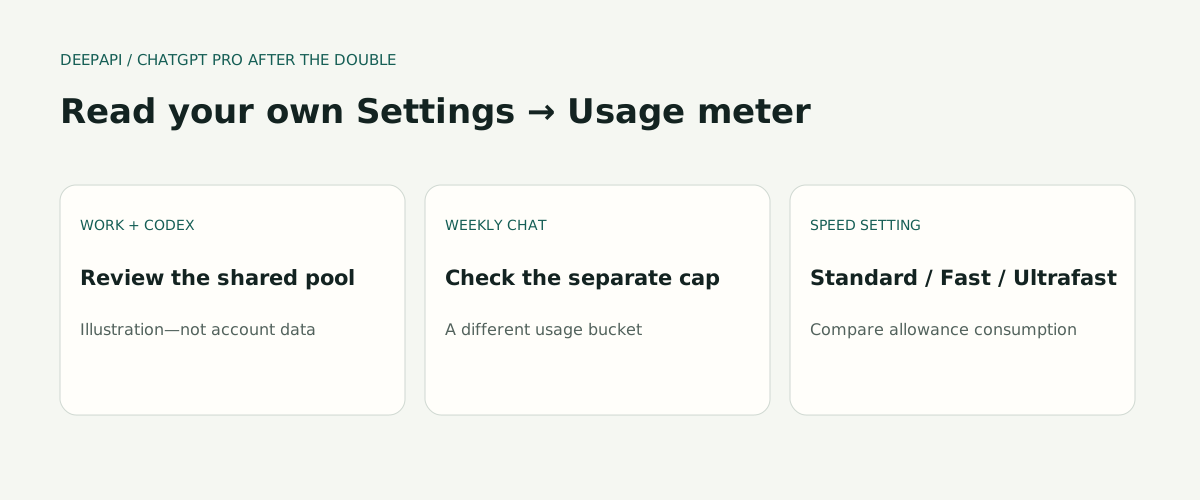
The Actionable Test: Open Settings → Usage in your account tonight. If your historical monthly consumption would fit comfortably within twice your old baseline, you can safely drop from $200 down to $100, saving $1,200 annually.
Stay on—or Move to—Pro 200 ($200)
For months, the conventional advice regarding Pro 200 was defensive. Subscribers clung to their accounts because letting them lapse meant losing grandfathered status, as explored in our previous ChatGPT Pro 500 vs 200 comparison written during the grace period.
With the planned reduction officially canceled and lower tiers matched upward, Pro 200 is no longer a defensive hold—it must be justified on pure computational volume.
Who Belongs on Pro 200?
- Full-Time Automated Engineers: If your terminal runs Codex continuously throughout an 8-hour workday to scaffold microservices, debug pull requests, and inspect continuous deployment logs, Pro 100’s allocation will still run dry by mid-month.
- High-Reasoning Multi-File Operations: When parsing massive codebases where every prompt loads thousands of contextual tokens and triggers recursive chain-of-thought steps, you need the expanded headroom that only Pro 200 provides.
- Teams Re-subscribing After a Lapse: If you paused your subscription during the September turbulence, you do not need to fear degraded allowances. Official Help documentation confirms that new and returning Pro 200 subscribers receive the updated, higher standardized allowance immediately upon checkout.
If your team is managing massive code bases, pair your subscription with techniques from our guide on reducing Codex token usage through context compaction to maximize your effective monthly mileage.
When Pro 500 Still Wins
At $500 per month—the cost of twenty-five standard Plus accounts—Pro 500 remains an aggressive capital commitment. The quota doubling on October 29 applied to Pro 500 as well, doubling its already massive Work & Codex allowance.
However, buying Pro 500 is almost never about standard throughput. Pro 500 exists for one primary reason: Ultrafast access.
┌────────────────────────────────────────────────────────────────────────┐
│                      THE ULTRAFAST MULTIPLIER TRAP                     │
├────────────────────────────────────────────────────────────────────────┤
│ Standard Execution:   1.0× Allowance Burn Rate                         │
│ Fast Execution:       2.5× Allowance Burn Rate                         │
│ Ultrafast Execution:  8.0× Allowance Burn Rate                         │
│                                                                        │
│ Bottom Line: Running continuous Ultrafast reasoning burns through      │
│ even a doubled Pro 500 quota at eight times standard speed.           │
└────────────────────────────────────────────────────────────────────────┘
Help Center guidelines confirm that Ultrafast cannot be unlocked by purchasing supplemental credits on Pro 100 or Pro 200. It is hardcoded to the $500 tier. If your quantitative models, critical incident debugging, or live executive demonstrations demand real-time frontier reasoning without a two-minute waiting buffer, Pro 500 is your only native option inside ChatGPT.
If you are not actively leveraging Ultrafast mode on daily workflows, Pro 500 is overkill. Step down to Pro 200 and invest the remaining $300 into external tools or direct API credits.
A Separate Line Item: The October 28 API Credits
Just twenty-four hours before doubling Pro allowances, OpenAI rolled out a completely separate perk: monthly developer API credits for eligible ChatGPT subscriptions.
According to official Help documentation on API credits benefits for eligible subscriptions, eligible Pro and Business subscribers can claim monthly credits directly on the OpenAI developer platform. In public announcements and official video titles, figures "up to $500/month" have appeared depending on account tier and tenure.
Crucial Purchasing Rule: Do not conflate your consumer Work & Codex quota with developer API credits:
- Your Work and Codex allowance powers in-app features inside ChatGPT (such as the web interface, native desktop app, and Codex workspace extensions).
- Your developer API credits are consumed via direct API keys on the OpenAI Platform (e.g., custom Python scripts, terminal cURL requests, or third-party web apps).
Having access to monthly API credits mirrors moves by competitors like Anthropic (where Claude Max and Ultra bundle monthly platform credits, as detailed in our fall 2026 subscription bill ladder). Treat this as an independent operational asset rather than double-counting it toward your web UI quota.
Stop Paying Pro: When to Move Spend to API
Despite the quota expansion, consumer Pro subscriptions carry inherent structural friction: flat monthly commitments, account-level concurrency caps, and locked model selections.
If your core workload involves headless data processing, multi-model evaluation, or scheduled background maintenance, maintaining a $200 or $500 monthly consumer seat is often an inefficient use of capital.
Why Developers Shift Budget to Direct Endpoints
- Pay Purely for Production: If your project work fluctuates—heavy during a two-week sprint and dormant the rest of the month—direct API billing eliminates recurring seat waste.
- Take Advantage of Plummeting Token Prices: As documented in our guide to fall 2026 API bills, commodity models like GPT-5.6 Luna slashed prices by 80% down to $0.20 per million input tokens, while DeepSeek introduced deep off-peak discounts. Running automated background tasks through consumer Pro allowances costs substantially more than routing them to specialized utility endpoints.
- Multi-Model Routing Flexibility: Utilizing gateways like OpenRouter enables automated failover between OpenAI, Anthropic, and open-weight models through a single balance (subject to standard platform purchase fees, such as OpenRouter's 5.5% credit fee). For teams building custom toolchains, inspect our review of open-source and compatible model routers.
If your usage lives inside terminal scripts and you never touch the interactive web canvas, cancel Pro and route your spending directly through the Model API Price index.
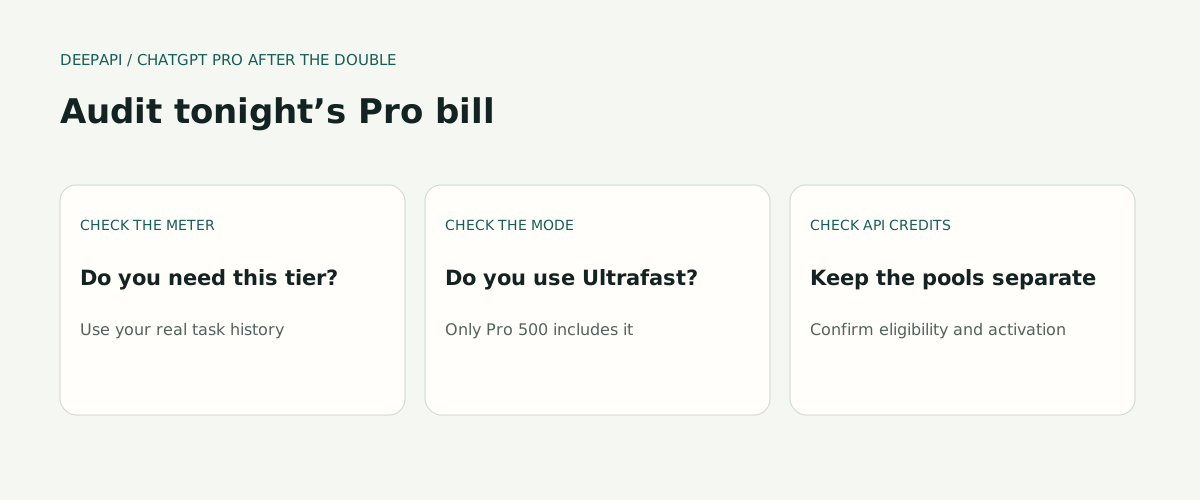
Tonight’s Pro Bill Checklist
Before your account automatically bills another $100, $200, or $500 this cycle, complete this practical eight-point audit:
- Inspect the Usage Gauge in Settings: Navigate to Settings → Usage. Did your total consumption over the past billing cycle cross 50% of your allowance? If not, the post-October 29 doubling means you can safely step down one tier.
- Separate Chat Caps from Codex Limits: Identify where your team actually encounters throttles. Are you hitting weekly message caps on interactive chat, or are you exhausting the shared Work & Codex pool?
- Audit Your Need for Ultrafast: Do you regularly execute reasoning tasks in Ultrafast mode? If the answer is no, cancel Pro 500 immediately; Pro 200 provides identical model access at less than half the monthly fee.
- Do Not Cancel Just to Reset: If you are currently on Pro 200, you do not need to cancel and resubscribe to receive updated limits. Help documentation confirms that updated allowances apply automatically.
- Claim Your Separate API Credits: Check your eligibility on the OpenAI platform under the October 28 benefit program. Ensure your engineering team is actively claiming and utilizing these developer credits.
- Review Fast Mode Overuse: Remember that Fast mode burns 2.5× your standard allowance. Setting your default preference to Standard mode can extend your doubled quota across the entire month.
- Verify Live Plan Pricing on Deepapi: Visit our Subscriptions hub and our ChatGPT directory to confirm active tier details and platform announcements.
- Evaluate Downward to Plus ($20): If your agentic scripting experiments have concluded and your primary daily need is standard conversational chat, drop back to the $20 baseline.
Frequently Asked Questions
Did OpenAI really double ChatGPT Pro quotas on October 29, 2026?
Yes. Effective October 29, OpenAI doubled the included Work and Codex allowance on Pro 100 and Pro 500, while aligning lower Pro 200 allowances upward to match higher tiers and formally canceling the planned Pro 200 reduction.
Is this update for consumer ChatGPT Pro or API pricing tiers?
This update applies strictly to consumer and team subscription tiers (ChatGPT Pro 100, 200, 500, and Business Premium). It does not alter the per-token pricing rate cards on the OpenAI Platform developer API.
What exactly doubled: Work and Codex vs weekly chat messages vs Plus?
The doubling applies specifically to the shared Work and Codex allowance used by coding extensions, terminal tools, and workspace environments. Weekly GPT-6 Pro conversational message limits in the standard chat window remained at their existing baseline for Pro 100 and Pro 500. Standard Plus plans received no quota increases.
If I am on Pro 200, did I get 2× or did I just keep my higher allowance?
If you already had the higher grandfathered allowance, your capacity was preserved and the planned cut was rescinded. If you were on the lower allowance introduced during the September restructuring, your quota was doubled to match the higher tier standard.
After the double, is Pro 100 enough, or should I still pay $200?
For most solo software engineers and technical analysts, Pro 100 ($100/mo) is now the sweet spot. With its Work & Codex allowance doubled, it provides ample capacity for daily development cycles. Maintain Pro 200 ($200/mo) only if you run intensive multi-file refactoring or continuous terminal agent loops that drain capacity mid-month.
When is Pro 500 still worth it?
Pro 500 ($500/mo) is only justified if your operations require Ultrafast reasoning mode (which is not available on lower tiers even with purchased add-on credits) or if your production requirements demand the absolute maximum included computational headroom.
How do the October 28 API credits change the math?
Eligible Pro and Business subscribers can claim monthly developer API credits as a separate platform benefit. Because this credit pool applies strictly to developer API endpoints, it supplements your in-app allowance without replacing it, providing extra value for teams that build custom external scripts.
When should I leave Pro and use direct API endpoints instead?
You should leave Pro if your workloads consist primarily of automated, headless tasks, scheduled batch data processing, or IDE extensions that support custom endpoints. Transitioning to direct API keys allows you to capture massive price cuts on commodity models and pay strictly for the tokens you generate.
The Bottom Line on Tonight’s Pro Bill
The October 29 policy shift brought welcome stability to an anxious subscriber base. By canceling the Pro 200 reduction and doubling the shared Work & Codex allowance for Pro 100 and Pro 500, OpenAI restored predictable value to its power tiers.
Tonight's decision comes down to disciplined capacity tracking:
- Stay on Pro 100 ($100) if you want professional developer limits without paying enterprise premiums.
- Maintain Pro 200 ($200) if your automated agent loops run all day and require serious headroom.
- Reserve Pro 500 ($500) exclusively for workflows that cannot survive without Ultrafast execution speeds.
Check your usage meters on your account, cross-reference live rates on our Subscriptions hub, track raw compute costs on Model API Price, and review our ongoing coverage on Today to ensure every software dollar drives real production value.
Current prices are on the price table.
Related
- 2026-10-03 · ChatGPT Pro 500 vs Pro 200: keep the $200, move to $500, or cancel
- 2026-11-02 · Fall 2026 Subscription Bill: One $20, a $40 Stack, or Graduate to Max/Pro?
- 2026-09-15 · Reduce Codex token usage without changing models
- 2026-11-05 · ChatGPT + Codex Share One Allowance in December: Stay on Plus, Upgrade Pro, Buy Credits, or Move to API?